Staying in control: money, time and the signs worth naming
Practical habits rather than slogans. Nothing here is clinical advice — it is the set of decisions that are far easier to make before a session than during one.
"Gamble responsibly" is printed on everything and means almost nothing on its own. What follows is the version with instructions attached: what to decide in advance, which controls make a decision hold, and what to watch for in your own behaviour. Every tool mentioned exists inside the account of any operator licensed for Great Britain.
Decide the money before you open the site
A budget chosen mid-session is not a budget, it is a negotiation you are losing. Set the figure while nothing is at stake, and treat it the way you would treat a concert ticket — money spent on an evening, gone whatever happens.
- Name the amount out loud. A specific figure for the week or month, not "a bit". Vague budgets fail because there is nothing to break.
- Set the deposit limit to match it. Every licensed account has one. Lowering it takes effect immediately; raising it has to wait out a cooling-off period, which is the whole reason it works.
- Keep gambling money separate from everything else. If it shares a pot with the food shop, the food shop eventually loses an argument.
- Never top up mid-session. The urge to add "just one more" deposit after a loss is the single most expensive habit in the room.
- Write off winnings the same way. Money won is still gambling money until you move it out and leave it out.
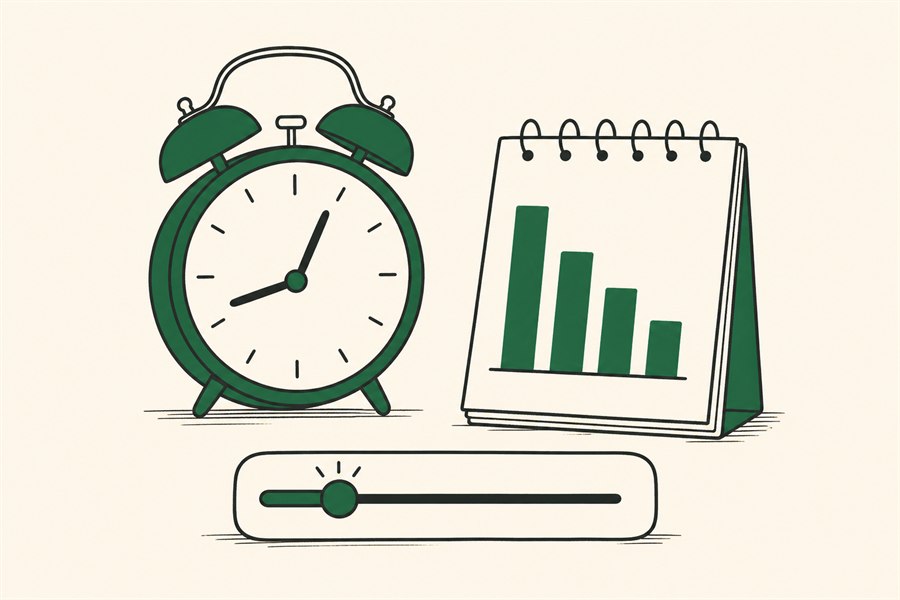
Time is the part people underestimate
Ask someone how much they spent and they will usually get close. Ask how long they played and the estimate falls apart. Online games run fast — a slot round takes a few seconds, and an hour disappears in what feels like twenty minutes.
The reality check exists for exactly this. Set it to interrupt you at an interval short enough to be slightly irritating: thirty minutes is a reasonable starting point, and if it makes you sigh, it is doing its job. Pair it with something external — a timer on your phone, or simply not starting after a certain hour, since late-night sessions are where judgement goes first.
A time-out is the next step up. Anything from a day to six weeks, applied instantly, no explanation required. It is worth using long before anything feels like a problem; treating it as an emergency measure only makes it harder to reach for when it matters.
If a session needs justifying while it is happening, that is information. Not proof of anything, but information worth sitting with.
Signs worth taking seriously
None of these is a diagnosis and no single one settles anything. Several appearing together, or one of them appearing repeatedly, is a reason to use a tool rather than to argue with yourself.
- Playing longer or for more than you intended, most times you play.
- Returning to win back a loss, then treating that as a plan.
- Being vague with people close to you about how much or how often.
- Gambling money that was meant for something with a deadline.
- Feeling restless or irritable on days you have not played.
- Thinking about the next session during work, or instead of sleeping.
- Borrowing to keep playing, in any form, from any source.
- Relief rather than enjoyment when a session goes well.
The maths, stated once and plainly
Every casino game is built with a house edge. Return to player is a long-run average measured across millions of rounds, and it describes the game rather than your evening — a 96% RTP does not mean £96 back from £100 in a session, and no sequence of results makes the next round more or less likely to land. Roulette has no memory. Neither does a slot.
This is why systems fail. Doubling after a loss, waiting for a colour that is "due", switching machines because one feels cold: each of these is a pattern imposed on randomness, and the arithmetic underneath is unaffected. Anyone selling a method to beat it is selling the method, not the results.
Making a decision stick
- Start with the account tools. Deposit limits, reality checks and time-outs are two taps away and reversible only in the direction that protects you.
- Add a bank block. Most UK banking apps can refuse gambling transactions, and several impose a delay before the block can be lifted.
- Install blocking software. Gamban, BetBlocker and similar tools restrict access at the device level, which covers the sites a self-exclusion does not reach.
- Use GAMSTOP if you want it all to stop. One free registration closes every GB-licensed gambling site to you for six months, one year or five, and it cannot be undone early.
- Tell one person. The single most effective step on this list, and the one most often skipped.
Where to get help today
Free, confidential and independent of this site or any operator. You do not need to be in crisis to call, and nothing has to have gone wrong yet.
-
 GamCare
National Gambling Helpline, live chat and one-to-one support, day and night.
GamCare
National Gambling Helpline, live chat and one-to-one support, day and night.
-
 GAMSTOP
One registration, every GB-licensed site closed to you at once.
GAMSTOP
One registration, every GB-licensed site closed to you at once.
-
 GambleAware
Self-assessment and a directory of treatment services near you.
GambleAware
Self-assessment and a directory of treatment services near you.
-
 UK Gambling Commission
What operators must do for you, and the public licence register.
UK Gambling Commission
What operators must do for you, and the public licence register.
Our responsible gambling page goes into the services and account tools in more detail.